Caswino Payment Methods Australia: Cards, Crypto and Cashier Facts
 Available in AU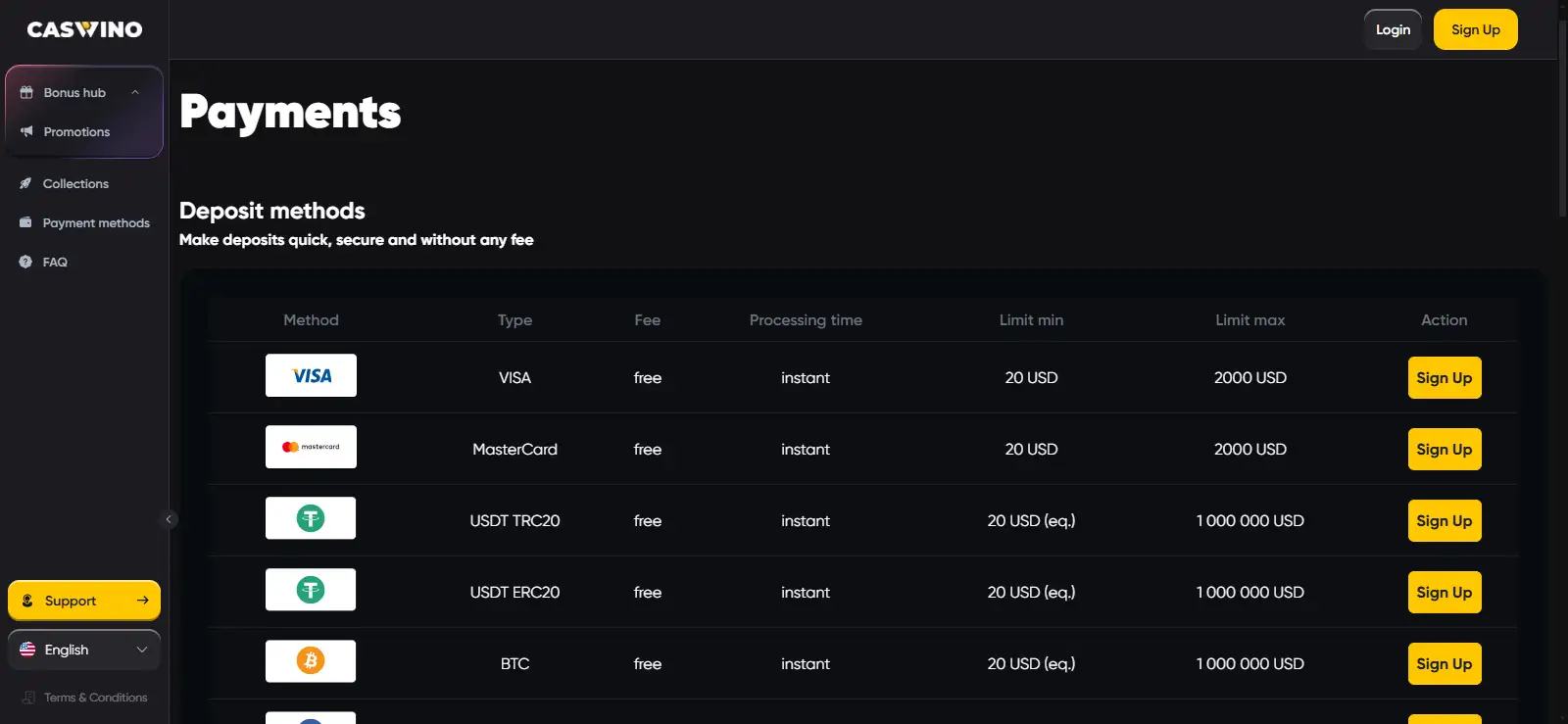
Caswino’s public payments page lists Visa, Mastercard, USDT on TRC20 and ERC20, Bitcoin, Litecoin, Ethereum, Dogecoin and TRON. The published deposit minimum is 20 USD for cards and 20 USD equivalent for the listed digital assets; the public page labels its listed methods free and instant. Those are public USD figures, not a view of any particular Australian account. Caswino says payment selection can vary by region. PayID is not established as available in an Australian Caswino cashier, and local currency presentation should not be inferred from the public table.
The public deposit limits appear in Caswino’s payment table.
Table of Contents
- Current public deposit methods
- Global public table versus an Australian cashier
- Choosing a method
- Deposits are not withdrawals
- What the public deposit table actually says
- Card payments and the issuer’s role
- Stablecoin networks must match
- Bitcoin, Litecoin, Ethereum, Dogecoin and TRON
- Public USD values are not an AUD quote
- PayID and other locally familiar methods
- Depositing is not the same as being eligible for an offer
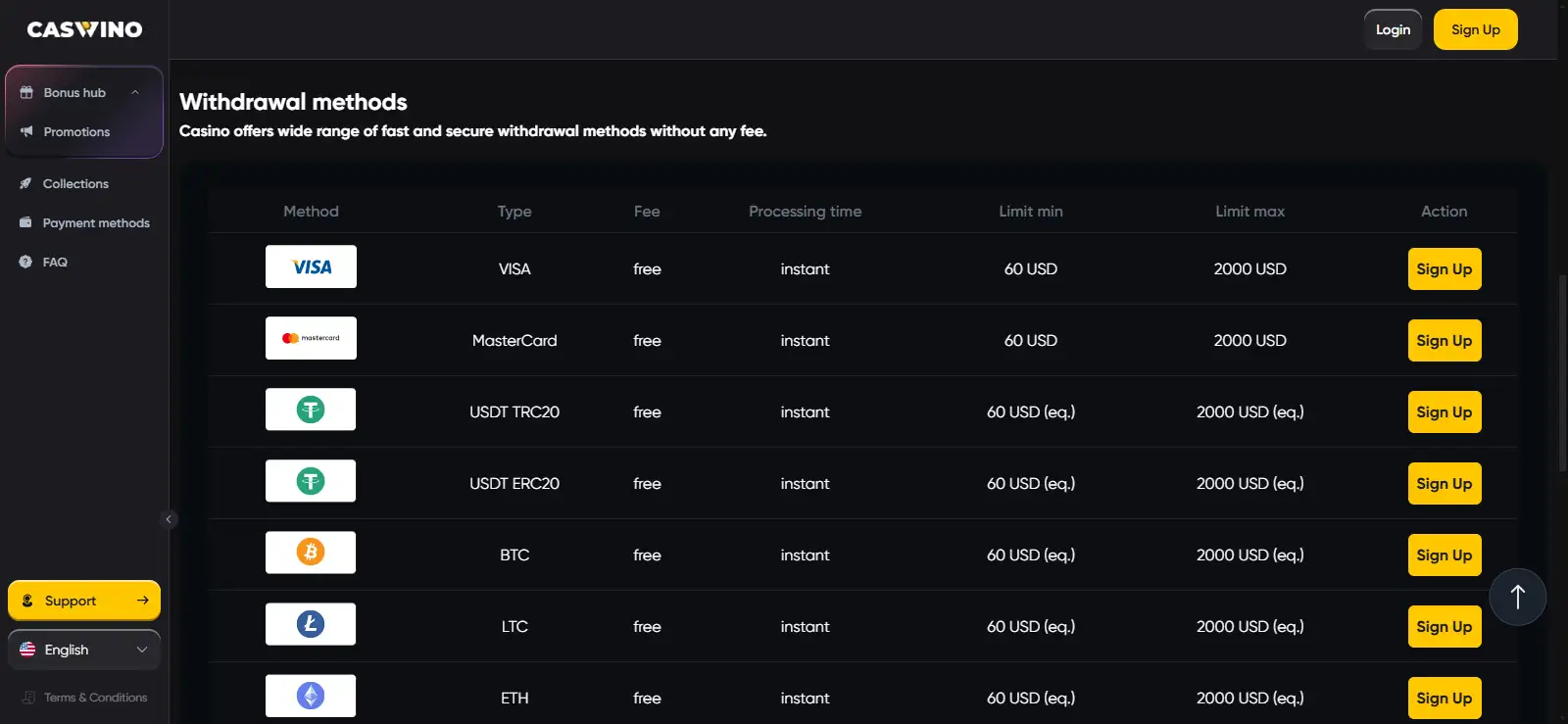
- Why the withdrawal table differs
- How to interpret a free or instant label
- Account security and transaction records
- Questions about the Caswino cashier
- Which Caswino payment options need an Australian cashier recheck
Current public deposit methods
| Method | Public-page fee | Public label | Published minimum |
|---|---|---|---|
| Visa / Mastercard | Free | Instant | 20 USD |
| USDT, BTC, LTC, ETH, DOGE, TRX | Free | Instant | 20 USD equivalent |
The public amounts are in USD. Your bank or digital-asset service can apply separate currency or network charges.
The Caswino Australia review provides a wider account of the service.
Global public table versus an Australian cashier
Caswino states that payment options can adapt by region. That means a public list establishes that the platform supports a method in general, while your logged-in cashier establishes what is actually offered to your account. PayID does not appear in the public method table; whether a particular account shows it is unknown.
Caswino licence and Australian rules explains why payment availability is not authorisation.
Choosing a method
Compare the currency shown, minimum amount, any external provider fee and whether the same payment route can be used for withdrawals. Crypto also adds network and wallet considerations outside Caswino itself. The public Caswino table says the listed methods are free on the operator side, but your bank, card issuer, exchange or blockchain can have separate costs.
Deposits are not withdrawals
The withdrawal table has different published limits, and KYC can affect the end-to-end payout process. Use the withdrawal guide rather than assuming a deposit label predicts cash-out speed.
What the public deposit table actually says
The published card rows show Visa and Mastercard deposits with a minimum of 20 USD and a maximum of 2,000 USD. The digital-asset rows list USDT on TRC20 and ERC20, BTC, LTC, ETH, DOGE and TRX with a 20 USD-equivalent minimum and a published maximum of 1,000,000 USD equivalent. These are figures on Caswino’s global payment page, not guaranteed limits for every account or a statement that any Australian bank will accept the transaction.
The payment page labels the listed deposits free and instant. Those labels describe the operator’s public table. A separate issuer decision, network confirmation, conversion or compliance check can affect what the user ultimately sees. In particular, a no-fee operator entry does not mean there can never be an exchange spread, blockchain network charge or fee outside Caswino’s control. The precise amount should be apparent at the payment confirmation stage.
Card payments and the issuer’s role
Visa and Mastercard are card networks, not promises that every card issued by a participating bank can fund every merchant. The issuer can apply its own controls, including gambling-related restrictions, international transaction rules and currency conversion. An approved public method therefore says something about Caswino’s payment options, not the suitability of any particular Australian card or the regulatory status of the casino service.
If a card transaction fails, the reason may concern the issuer, an incorrect account detail, a transaction limit or a service restriction. Repeated attempts do not necessarily resolve the underlying cause and can complicate the transaction record. For questions about an issuer’s charge or decision, the bank’s own information is relevant; for the casino account’s displayed status, the operator’s cashier and support channel are separate sources of information.
Stablecoin networks must match
Caswino’s public table distinguishes USDT TRC20 from USDT ERC20. The asset name alone is not enough to identify the receiving network. A transfer directed to the wrong network or incompatible address can be difficult or impossible to recover, depending on the wallet and transaction conditions. The exact asset, network and destination shown at the time of a transaction matter much more than a remembered address from an earlier deposit.
Network charges are separate from a casino’s statement that it does not charge an operator fee. A wallet or exchange can display its own withdrawal charge, and the effective value of a transfer depends on the asset amount and any conversion. There is no basis for describing a public USD-equivalent threshold as a fixed number of tokens without the live rate and wallet’s actual calculation.
Bitcoin, Litecoin, Ethereum, Dogecoin and TRON
The public table lists BTC, LTC, ETH, DOGE and TRX in addition to the two USDT routes. These are distinct assets with distinct networks and price behaviour. Caswino’s display of their names does not establish that an account can send one asset to another asset’s address, or that a user can fund the transaction through any exchange in Australia. A wallet’s supported asset and network must match the selected transaction.
For a volatile asset, a USD-equivalent minimum is a value threshold rather than a permanent quantity of coins. The asset amount needed to meet that threshold can change as prices change. The amount a user sends, the value recognised by the payment service and the balance displayed by the casino can therefore be different measures. The account’s transaction record is important when reconciling them.
Public USD values are not an AUD quote
Caswino’s published deposit table uses USD for card limits and USD equivalents for crypto. That does not imply that an Australian account necessarily uses USD throughout its interface, or that a quoted public number converts to the same AUD amount on every date. Card issuers, wallets and currency providers can use their own rates or spreads, and a rate can change between opening a page and completing a transaction.
It helps to keep three figures distinct: the method’s public eligibility threshold, the amount charged by the payment provider, and the balance credited to the casino account. The first comes from the public method table; the other two relate to the actual transaction. A statement that a currency is supported should not be inferred from a geographical label or from the fact that a payment card has an Australian issuer.
PayID and other locally familiar methods
PayID is a familiar Australian payment term, but it does not appear in Caswino’s public method table. The operator’s general support description says a cashier can adapt by region; that statement does not identify which Australian bank-transfer method, if any, appears for every person. Consequently PayID must remain an open account-specific question rather than a confirmed Caswino deposit option.
The same distinction applies to e-wallets and vouchers mentioned in Caswino’s wider support description. A generic statement that an operator has used a payment category is not a current, account-specific listing. The visible cashier, amount and applicable method conditions govern the individual transaction. An unavailable button should not be replaced by an assumed alternative route or an attempt to bypass location or banking restrictions.
Depositing is not the same as being eligible for an offer
A deposit can satisfy a method’s general minimum while failing to meet the terms of a promotion. A welcome offer can set a separate qualifying amount, excluded methods or an opt-in requirement. Caswino’s public promotional descriptions refer to region-adjusted offers and account-level choices, which means the payment and promotion details need to be read together when a bonus is involved.
If a deposit is made without a promotion, the ordinary payment conditions remain relevant. If a promotion is selected, its separate wagering and withdrawal restrictions can affect the account balance. Neither the payment confirmation nor a promotional credit establishes that online casino services are permitted for providers to offer people in Australia.
Caswino bonus covers any deposit-linked offer conditions.
Why the withdrawal table differs
Caswino’s public withdrawal minimum is higher than the public deposit minimum, and its withdrawal maximum is different from the high maximum shown in the crypto deposit rows. A person cannot infer cash-out eligibility from the size of an earlier deposit alone. The type of route, account status and pending identity checks can matter even if the public method names look identical in both tables.
A card deposit also does not guarantee that a card payout will be accepted for a particular account, just as an on-chain deposit does not determine all future payout settings. The operator’s current withdrawal route, beneficiary rules and account instructions should govern the request. Money moving into an account and money leaving it are separate operations with different thresholds.
Caswino withdrawals sets out the separate payout limits and steps.
How to interpret a free or instant label
When a table displays free, it usually concerns the charge shown by the operator for that listed method. It is not a declaration about exchange rates, card fees or network costs elsewhere. When the table displays instant, it describes a processing category, not a guaranteed end-to-end completion time under every condition. A pending account review or payment-provider delay can create a different experience.
These distinctions are particularly important when comparing cards and digital assets. An on-chain transaction has a network confirmation process, while a card transaction involves issuer and payment-service decisions. Caswino’s public labels should be read alongside the actual transaction details rather than treated as an assurance that every method has identical timing and cost.
Account security and transaction records
Payment details, wallet addresses and transaction confirmations are sensitive. Use the account’s own secure channels rather than sending a card number or identity document in an unsolicited message. A wallet address should be taken from the transaction currently being prepared, with the selected asset and network visible. These precautions concern the general mechanics of payments; they do not establish that the casino accepts a specific account or jurisdiction.
A transaction reference, amount, date, method and current status help distinguish an attempted payment from a completed one. Where money has left a bank or wallet but has not appeared in the casino account, those details allow the separate services to identify the transaction. A balance animation or an on-screen notification by itself is less useful than the recorded transaction status.
Caswino registration discusses account information and access.
Questions about the Caswino cashier
Is PayID definitely offered in Australia?
The public method list does not include PayID, and Australian account options can vary. The public method table does not list it.
Does the 20 USD minimum mean 20 Australian dollars?
No. USD and AUD are different currencies. The public card threshold is in USD and the crypto threshold is expressed as a USD equivalent.
Does free mean no charges anywhere?
It reflects the operator’s published fee for listed methods. External issuer, exchange or network charges are separate.
Which Caswino payment options need an Australian cashier recheck
Caswino’s public payments page lists Visa, Mastercard, USDT on TRC20 and ERC20, Bitcoin, Litecoin, Ethereum, Dogecoin and TRON. A public list of methods is not an individual transaction quote. The currency, permitted route and total cost depend on the actual account and provider.
Created by the ”Caswino Casino” editorial team.